
Process Design Is the Missing Link in Protein Scale-Up
Crystal Dinh on What It Takes to Scale Protein Processes Successfully As alternative proteins move from innovation to commercialization, the bottleneck is shifting from formulation to process. Plant-based and hybrid proteins are inherently variable. Hydration changes, viscosity shifts, and ingredient…
Crystal Dinh on What It Takes to Scale Protein Processes Successfully
As alternative proteins move from innovation to commercialization, the bottleneck is shifting from formulation to process. Plant-based and hybrid proteins are inherently variable. Hydration changes, viscosity shifts, and ingredient behavior can vary batch to batch. The result is familiar: inconsistent texture, yield loss, and production inefficiency.
More importantly, process is what defines the product. Structure, mouthfeel, and overall eating experience are all shaped by how proteins are hydrated, mixed, and thermally treated. Without control, you get mushy, rubbery, grainy, or unstable products, regardless of formulation.
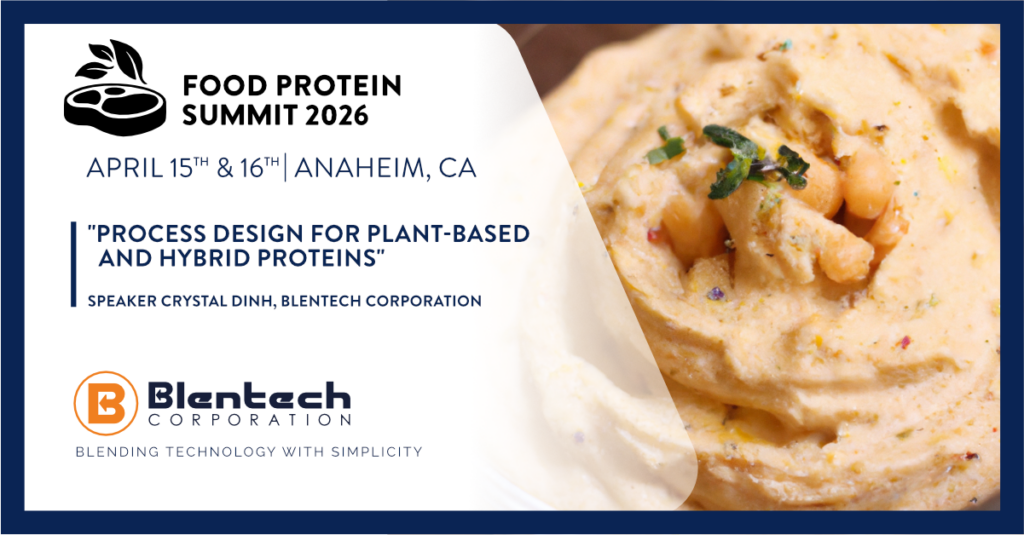
At the Food Protein Summit, Crystal Dinh, Blentech’s Applications Engineering Manager, will focus directly on this in her session, “Process Design for Plant-Based and Hybrid Proteins.”
Her approach is straightforward:
- Control thermal, shear, and mixing conditions to protect and develop protein structure
- Design systems that adapt to real product behavior like hydration, viscosity, and particulates
- Use automation and data to stabilize outcomes and reduce waste
This is where scale-up succeeds or fails.
Built on Real Results
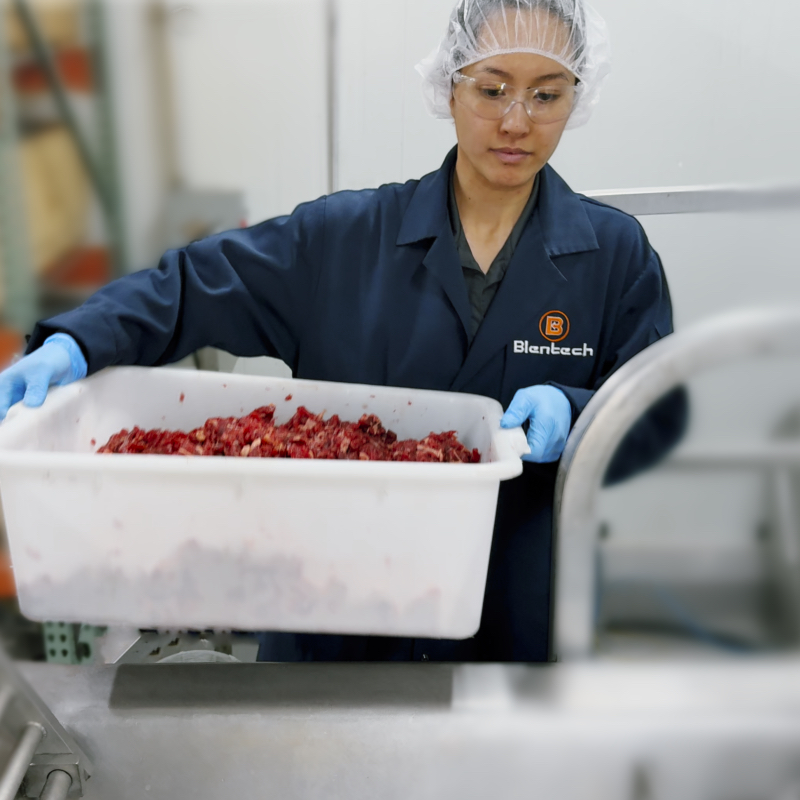
Crystal’s work is grounded in production outcomes, not theory. Her engineering leadership has helped processors achieve up to 80% cycle time reduction and 10% yield improvement, while improving how systems are designed and delivered.
She brings a systems-level approach to process optimization, combining equipment design with real-world plant constraints to solve complex formulation and scale-up challenges.
Her experience spans viscous foods and emerging protein systems, where process precision directly determines texture, consistency, and performance..
Why It Matters
Across plant-based, fermentation, and hybrid proteins, the core challenges remain the same: preserving texture, managing process variability, and achieving throughput targets without sacrificing safety or sensory quality.
The common denominator is process design. If the process isn’t stable, the product isn’t scalable.
Start With a Process Assessment
At Blentech, we start with the product and engineer the system around it. A process assessment shows where variability, inefficiency, or risk is being introduced and identifies how to eliminate it through better thermal control, mixing, and system integration.
The result: more consistent texture, less waste, and predictable throughput. If you’re attending the Protein Summit, connect with Crystal.
Or reach out to start a process assessment and turn your process into a competitive advantage.