
No More Dead Zones: Why Your Kettle Valve Matters
Eliminate Dead Zones with Sanitary Flush-Mount Kettle Valves In food processing, the integrity of your system is defined by its parts. While mixers and cookers often get the glory, the humble discharge valve can be a hidden source of inefficiency…
Eliminate Dead Zones with Sanitary Flush-Mount Kettle Valves
In food processing, the integrity of your system is defined by its parts. While mixers and cookers often get the glory, the humble discharge valve can be a hidden source of inefficiency and contamination.
If you are operating with traditional ball or butterfly valves, you are likely battling dead zones—recessed areas where product gets trapped, unmixed, and sometimes uncooked.
At Blentech, we’ve engineered a solution that closes the gap between processing performance and hygiene: the Sanitary Flush-Mount Kettle Valve.
Dead zones in kettle valves are recessed areas where product stagnates instead of fully draining. These trapped pockets increase contamination risk, reduce yield, and compromise batch consistency. A flush-mount sanitary valve eliminates entrapment areas and supports true CIP cleaning.
What Are Dead Zones in Kettle Valves?
A dead zone in a food processing valve is an internal pocket or recess where product can collect and remain after discharge. Over time, these areas can lead to:
- Product buildup
- Incomplete processing
- Longer cleaning cycles
- Increased contamination risk
Dead zones are most common in traditional valve designs that were not engineered specifically for hygienic food production.
Why Traditional Ball and Butterfly Valves Create Product Entrapment
Standard ball and butterfly valves often leave a cavity between the valve and the kettle wall. That recessed geometry creates a space where food can hide—especially in viscous or particulate-heavy products.
For processors running sauces, meat blends, pet food, or prepared meals, that trapped material becomes a sanitation and consistency problem fast.
The Flush-Mount Advantage: Eliminating Dead Spaces Completely
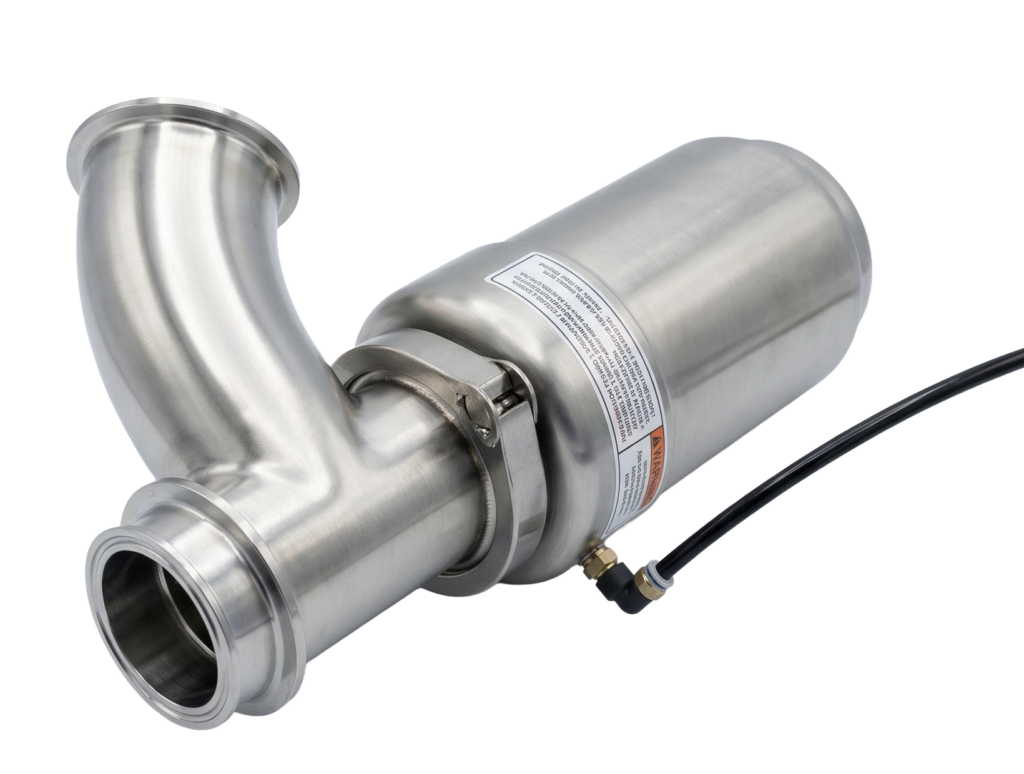
Our valve technology is refined through decades of experience to solve specific challenges like viscosity and particulate integrity. Unlike standard valves that leave a recess where food can hide, our Flush-Mount design uses a proprietary plug and seal interface to eliminate these dead spaces completely.
- Enhanced Food Safety: By eliminating entrapment areas, we minimize contamination risks—a critical benefit for sensitive applications like meat and pet food production.
- 100% Processing: The flush-mounted interface ensures every ounce of product is processed and discharged, preventing unmixed ingredients from ruining a batch.
- High Flow Rates: The wide, open port design optimizes production for both thin liquids and viscous products, ensuring efficient discharge.
- Precision Control: An integrated, adjustable air cylinder allows for precise control, giving you the option of full or partial flow.
True Clean-in-Place (CIP) Valve Design
Hygiene shouldn’t require a toolbox. Built on our “Clean Assist” philosophy, our valves are designed to reduce manual intervention.
- Automated Cleaning Without Disassembly: These valves can be supplied in a CIP configuration, allowing for automated cleaning cycles without manual breakdown.
- Food-Safe Materials and Regulatory Compliance: Constructed from stainless steel with food-safe, high-temperature elastomer components, these valves are USDA and CE approved and resistant to common cleaning chemicals.
- Low-Maintenance Operation: The simple design ensures reliable performance over time. For facilities that prefer it, the unit can also be easily removed for clean-out-of-place environments.
Flexible Installation Options for Safer Discharge
We know that facility footprints vary. That’s why our valves are designed for versatility. They can be installed in the end wall, belly, or discharge door of your equipment. Installing on a discharge door, for example, allows for safe, fast discharge of fluids without splashing.
Safety is also built into the maintenance process:
- Quick-Release Valves: Available to manually release stored pneumatic energy, mitigating risks during maintenance or inspection.
- Valve Cradle: An optional device that enhances safety and speeds up disassembly for clean-out-of-place environments.
- Robust Construction: Built to withstand the demands of high-volume food processing, offering unmatched reliability and durability.
Upgrade Performance Without Replacing Your Cooker
You don’t need to buy a whole new cooker to get better performance. Our CIP-compatible valves are retrofittable onto legacy Blentech machines and even third-party systems. They are available for individual sale in 4”, 6”, and custom sizes to fit your specific production needs
A flush-mount valve isn’t just a hygiene upgrade—it’s an OEE and total cost lever. By removing product entrapment points, you reduce avoidable risk and reclaim time and product that typically disappear into cleanup, rework, and losses.
Reduce contamination risk by eliminating trapped-product pockets
Improve yield and batch consistency with full-drain discharge
Shorten cleaning cycles with true CIP capability
Extend equipment life through durable, low-maintenance design
Retrofit instead of replace to upgrade without major capital expense
If your current discharge valve is creating pockets, it’s quietly costing you every run.
What causes dead zones in kettle valves?
Dead zones are typically caused by recessed valve cavities in traditional ball or butterfly valves where product cannot fully drain.
Why are dead zones a food safety risk?
Trapped product can harbor bacteria, cause allergen cross-contact, and lead to incomplete cleaning during CIP cycles.
Can sanitary flush-mount valves be retrofitted?
Yes. Blentech flush-mount kettle valves can be retrofitted to legacy Blentech equipment and many third-party systems.
Are flush-mount valves compatible with CIP systems?
Yes. These valves can be configured for automated Clean-in-Place operation without manual disassembly.