
Before You Spec Another Scraped-Surface Heat Exchanger
Fruit preps, syrups, sauces and dairy bases often end up on scraped-surface heat exchangers out of habit. Those units work, but they come with rotating shafts, seals and scraper blades that wear out and shut the line down for rebuilds….
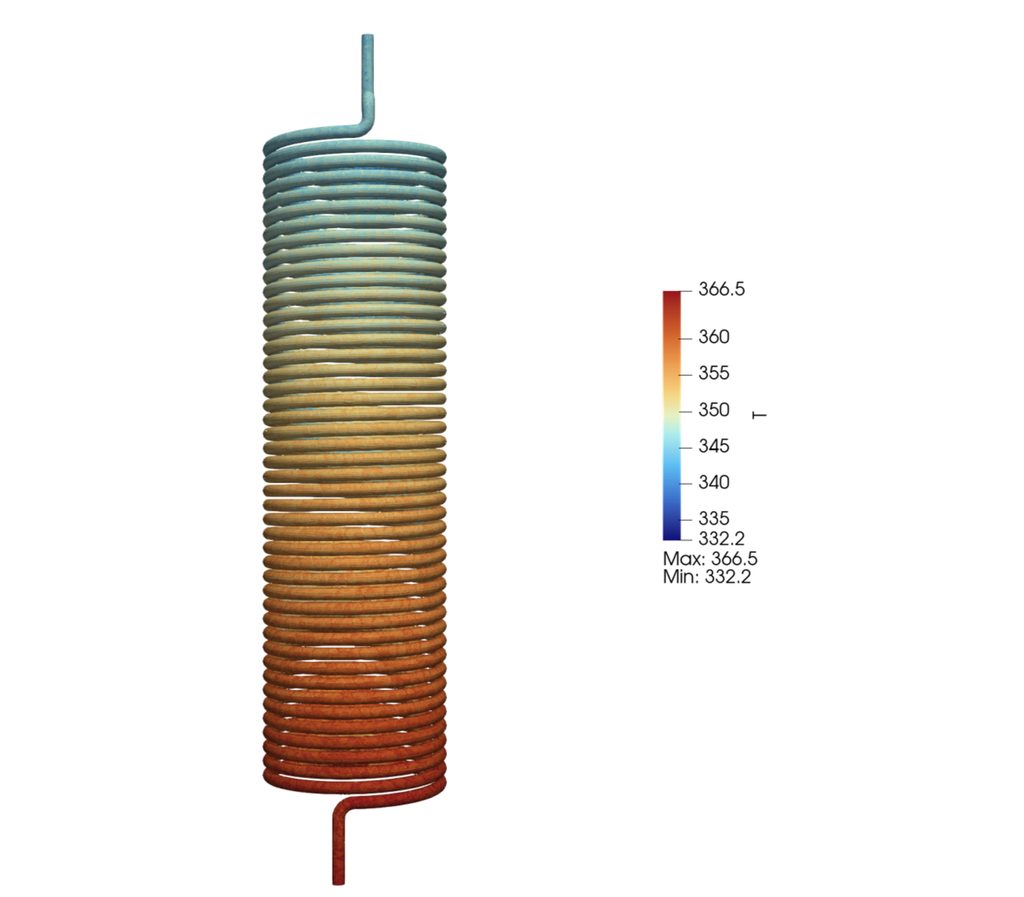
Fruit preps, syrups, sauces and dairy bases often end up on scraped-surface heat exchangers out of habit. Those units work, but they come with rotating shafts, seals and scraper blades that wear out and shut the line down for rebuilds. For many mid- to high-viscosity products, a sanitary helical coil can do the same job with no moving parts.
Why the coil shape matters
In a straight tube, viscous product near the wall barely moves. That slow layer insulates the rest of the product from the heating or cooling surface, and it’s where burn-on starts. Coiling the tube changes that. As product travels around the curve, centrifugal force sets up two counter-rotating eddies across the tube, called Dean vortices. They keep rolling product from the center to the wall and back, which breaks up the slow layer and raises heat transfer. The shape of the tube does the mixing a scraper would otherwise do.
When Not to Choose Helical Coils
A coil isn’t right for every product. Heavy particulates and products that foul aggressively still belong on a scraped-surface unit.
Engineered around your product
Once a coil is wound you can’t reach inside it, so the design has to be right before the tube is bent. That’s why we size each coil around how the product actually flows:
- Tube diameter set for pressure drop, so your pumps aren’t fighting backpressure
- CFD modeling to confirm the heating or cooling profile before fabrication
- FEA to check supports and welds against repeated thermal cycling up to 250°F
- Purged orbital welds for smooth, CIP-ready internal surfaces
Learn More
Download the Helical Coil Heat Exchanger brochure for specifications, CFD cross-sections and system configurations.
DOWNLOAD BROCHURERead how Lyons Magnus replaced aging hydrocoolers and gained 17% in cooling efficiency without giving up an inch of floor space.
READ CASE STUDYWondering if a helical coil fits your product? Tell us a little about it (viscosity, flow rate, target temperatures), and one of our process engineers will walk through the options with you. Contact Us
Helical Coil Heat Exchanger FAQ
What is a sanitary helical coil heat exchanger?
A sanitary helical coil heat exchanger transfers heat through the wall of coiled tubing to heat or cool a flowing food product. The curved tubing promotes circulation within the product stream, while sanitary construction supports clean-in-place procedures.
How does a helical coil improve heat transfer?
As product flows through curved tubing, secondary circulation called Dean vortices can move product between the center of the tube and the wall. This circulation improves heat transfer by reducing the insulating effect of the slower-moving layer near the tube wall. The amount of improvement depends on product properties, flow rate, and coil geometry.
Can a helical coil replace a scraped-surface heat exchanger?
A helical coil may replace a scraped-surface heat exchanger when the product can achieve the required heating or cooling performance without mechanical scraping. Selection depends on viscosity, fouling behavior, particle characteristics, allowable pressure drop, and cleaning requirements. Products that need continuous removal of deposits may still require scraped-surface equipment.
Can helical coil heat exchangers handle viscous food products?
Helical coil heat exchangers can handle suitable pumpable, viscous food products. Engineers must evaluate how viscosity changes with temperature and shear, along with the required flow rate and available pump pressure. Viscosity alone does not determine whether a coil is appropriate.
Can a sanitary helical coil heat exchanger be cleaned in place?
A sanitary helical coil heat exchanger can be designed for clean-in-place, or CIP, cleaning. Effective cleaning depends on internal surface quality, weld quality, system layout, and a cleaning cycle suited to the product residue. Cleaning performance must be validated for the application.
What information is needed to size a helical coil heat exchanger?
Sizing requires the product’s flow rate, inlet and target outlet temperatures, viscosity across the operating temperature range, thermal properties, particle characteristics, and fouling behavior. Engineers also need utility temperatures and flow rates, allowable pressure drop, cleaning requirements, and available installation space.