
Industrial Food Processing Kettles: Hemispherical, Horizontal & Conical
Built around how your product behaves
Blentech configures every kettle with the agitation, scraping, heating, and discharge your product needs, from soups and sauces to meat fillings and plant-based proteins. Not sure which geometry fits? Our free guide compares all three.
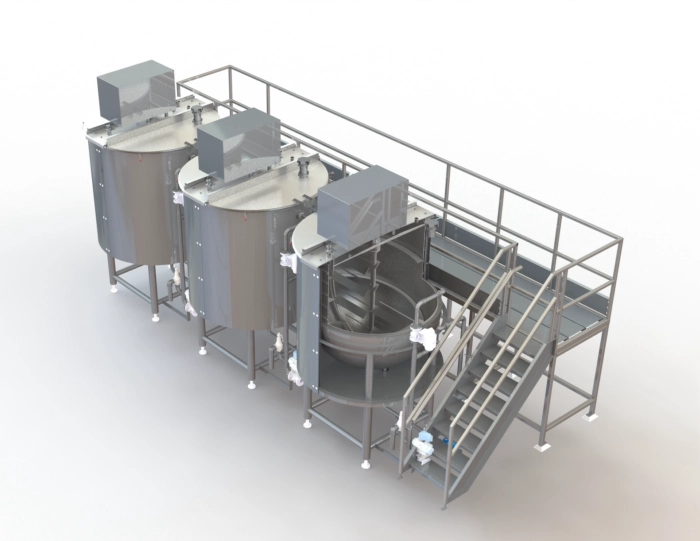
Capacity is only the starting point
Two kettles with the same stated capacity can perform very differently once the product starts heating. Starches hydrate, proteins set, fats render, and water cooks off, so a sauce that pours easily at loading may barely move twenty minutes later. The right kettle is the one whose geometry and agitation still move, heat, and discharge your product at that most difficult point.
Blentech builds every major kettle configuration, and we start each project with how your product behaves from loading through cleanup.
Compare common kettle types
Blentech builds every major kettle configuration. We build horizontal kettles because horizontal agitation lifts and folds thick, sticky, and particulate-heavy products that won't circulate on their own. When a hemispherical kettle is the better fit, ours is built differently, with a dual-concentric agitator that moves product through the full depth of the batch.
| Kettle type | Best for | Key advantages |
|---|---|---|
| Hemispherical | Soups, gravies, dairy, and other low-viscosity products in small batches | Familiar form factor, simplicity |
| Tilting | Viscous products in small batches with frequent or complete discharge needs | Simplified unloading, ergonomic handling |
| Conical | Products requiring full drainage or separation | High surface area for faster heating, complete discharge |
| Horizontal Our focus | Particulate, viscous, or delicate applications | Versatile, thermally efficient, and gentle mixing with effective scraping, easy loading, and streamlined layout integration |
| Vacuum | Concentrates, fillings, heat-sensitive products | Low-temp cooking, flavor/color retention |
Choosing the right kettle configuration plays a critical role in:
Improving batch consistency and product texture
Reducing energy and labor costs while streamlining sanitation and clean-in-place
Scaling up or automating recipes
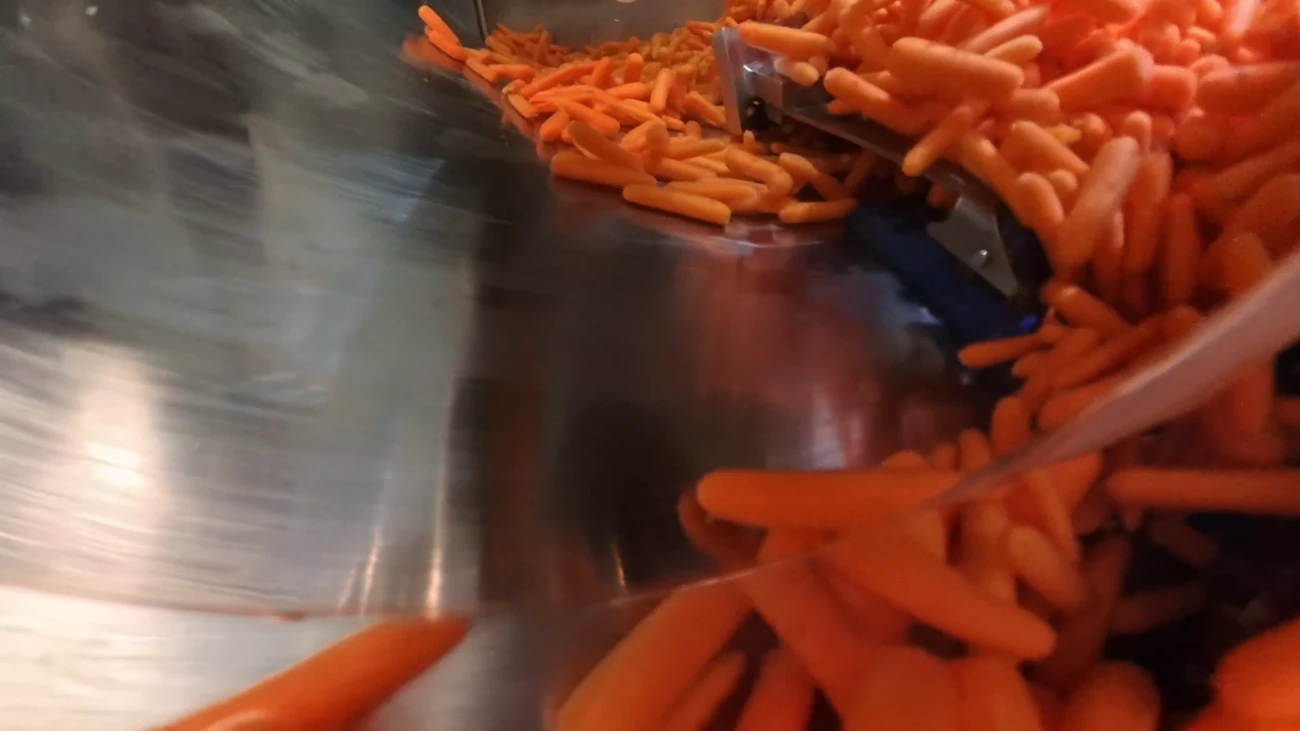
Our focus
A horizontal kettle for even distribution
Thick sauces, meat fillings, beans, and plant-based proteins get harder to move as they cook. In a deep vessel, product near the agitator turns over while the rest sits against the wall, where it can scorch or settle, and at the end of the batch it may barely flow toward the outlet.
A Blentech horizontal kettle spreads the batch through a long, shallow vessel and moves it mechanically. Ribbon, paddle, or combined agitators lift and fold the whole batch at low speed, and spring-loaded scrapers keep clearing the heated wall so fresh product reaches it. Because the agitator moves a large volume with each turn, shear stays low enough that pieces of meat, vegetables, and pasta stay recognizable in the finished product.
The same platform can cook, brown, reduce, and cool in one vessel, which cuts transfers between steps. A horizontal kettle does need more floor space than a vertical vessel of the same capacity, and its shaft seals need planned maintenance, so we review seal access and maintenance with your team during design.
The Blentech Difference
- 01Controllable Shear
- 02Reversible Agitation
- 03Multi-Life Jacket
- 04Zoned Heating
- 05Features Matched to Product
- 06Automated Smart Kettle
A hemispherical kettle that moves the whole batch
Most hemispherical kettles rely on an anchor or a single propeller, plus the curve of the bowl, to move product. That works for thin sauces, but as a batch thickens or picks up meat and vegetables, heavy ingredients settle to the bottom and light ones collect at the surface.
Blentech hemispherical kettles use a dual-concentric agitator. The outer ribbon carries product up and down through the depth of the batch while the inner agitator circulates it, and spring-loaded scrapers keep fresh product against the heated wall. Because the scrapers are spring loaded, the agitator can run in either direction, so the recipe can change the flow pattern as the product changes.
The result is a compact kettle that handles thin liquids, thick sauces, and chunky formulations. For very large batches or recipes built around heavy reduction, we'll show you how a horizontal kettle compares, because batch depth still affects heating time in any vertical vessel.
The Blentech Difference
- 01Top-to-Bottom Mixing
- 02Reversible Agitation
- 03Multi-Life Jacket
- 04Field Serviceable
- 05Sanitary Discharge
- 06Automated Smart Kettle
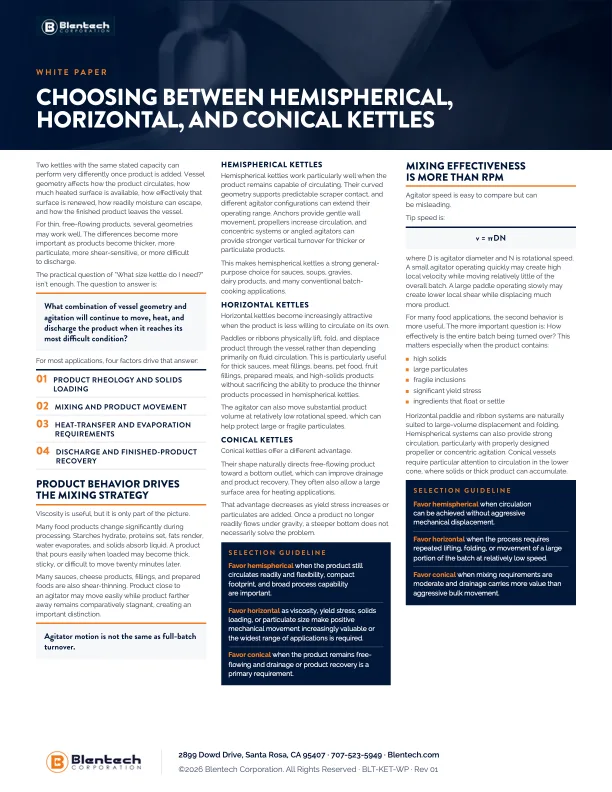
Get the kettle selection guide
Most hemispherical kettles rely on an anchor or a single propeller, plus the curve of the bowl, to move product. That works for thin sauces, but as a batch thickens or picks up meat and vegetables, heavy ingredients settle to the bottom and light ones collect at the surface.
The result is a compact kettle that handles thin liquids, thick sauces, and chunky formulations. For very large batches or recipes built around heavy reduction, we'll show you how a horizontal kettle compares, because batch depth still affects heating time in any vertical vessel.
Download white paperSee it in production
Watch the Dafgårds system bring material handling, cooking, discharge, and vacuum cooling together, moving product through each processing step in one integrated line
Learn more about Dafgårds and Blentech
Hanssens Catering combined Blentech equipment with AutoChef® and ARTIS® to manage recipes, guide operators, and review production across three facilities.
Read the Hanssens storyConfigured for your process
Every kettle is configured around your product, from how it heats and cools to how it leaves the vessel.
Options:
- 01Scraper materials matched to your product, temperature, and wear
- 02Direct steam injection and high-shear mixing
- 03Jacketed, vacuum, and cryogenic cooling
- 04Independently controlled heating zones on horizontal systems
- 05Clean-in-Place Solutions
- 06AutoChef recipe control and ARTIS production intelligence
Built to be serviced
Blentech kettles have repairable jackets, agitator seals that can be replaced without pulling the full assembly, and flush-mounted discharge valves that leave fewer places for product to hide during sanitation. When equipment is designed to be repaired in place, maintenance takes less downtime and the kettle stays in service longer.
Kettle applications in commercial food production
Blentech horizontal kettles are trusted for a wide range of applications. If your food process involves cooking, mixing, or heating, there’s a Blentech kettle system that can do it better.
Food Ingredients & Functional Foods
Precision for High-Value IngredientsBeverage Components & Syrups
Consistency for High-Value BasesFruit & Vegetable Processing
Gentle Handling, Consistent ResultsConfectionery, Snacks & Bars
Precision for Sweet and Savory ApplicationsGrains & Pasta
Reliable Results Across Starches and FillingsPet Food & Treats
Nutrition and Quality Without CompromisePrepared Meals, Entrées & Side Dishes
Systems Built for Meal ComplexityMeat, Poultry & Seafood
Precision Protein ProcessingDairy & Dairy Alternatives
Precision for Dairy InnovationSauces, Dips, Dressings & Condiments
Flexible Systems for Every Style
Let’s rethink what a kettle can do
At Blentech, we don’t just build kettles—we design integrated thermal processing systems for real-world food production. With advanced tools like our AI-powered AutoChef™ control system and ARTIS™ data platform, you can further optimize cooking precision, repeatability, and operational insights.