
How Shear Works in Cookers and Mixers
Prevent separation by dialing in the exact force needed, regardless of viscosity, to bind fats and liquids into a smooth, lasting texture.
What Shear Really Is
Think of shear as a cutting action, similar to a pair of scissors. It is a lateral force applied to the product, created when ingredients are forced to move at different speeds or in opposing directions. This action physically slices, pulls, or breaks down the product structure.
That sliding action—one layer pulling past another—creates friction, but shear rate and total shear matter greatly. Low shear keeps ingredients suspended without deterioration, while high intensity or longer duration breaks structures down to create stable emulsions.
A familiar way to picture it
A familiar way to picture it
Stirring combines ingredients; shear transforms them. In mixers and cookers, this is the difference between a separated mixture and a stable product.
Take processed cheese: without shear, heating just separates the fat. By applying shear, we force the ingredients into a new structure, locking the fat and liquid together to create a smooth sauce that won't break.
Low, High, and Staged (variable) shear
Low Shear
Low shear keeps structure intact. It folds, coats, or suspends particulates without changing their shape—ideal for maintaining distinct grains or diced vegetables.
High Shear
High shear adds energy. It pushes product through tight gaps or rotating blades, breaking particles and dispersing fats, starches, or proteins into a smooth, unified texture. That’s what creates stable emulsions, creamy dips, and refined sauces.
Staged Shear
For applications like shredded meats, AutoChef utilizes staged shear: applying high energy initially to shred the protein, then automatically switching to low shear to mix and coat the fibers without turning them into paste.
The Blentech Difference
While low shear mixes and high shear refines, Blentech offers batch and inline solutions to deliver both. Our systems allow for precise staged shear, ensuring you can transition seamlessly from gentle folding to high-speed emulsification within the same process—adding the right amount of energy at the exact right step.
Where Shear Matters Most
Fruit fillings and purees
Creating even body and flow without unwanted fibers or separation.
Condiments, dressings, and spreads
Including emulsified sauces, gravies, and reductions where fat and water must be held together for lasting stability.
Hummus, refried beans, and dense dips
Achieving uniform viscosity and particle reduction while ensuring clean discharge.
Powder and gum dispersions
Hydrating starch slurries, protein bases, and gums (especially in plant-based products) to achieve a smooth texture without overprocessing solids.
Cheese and dairy-based sauces
We precisely dial in shear to improve meltability and stretchability, creating a smooth, glossy consistency without the graininess or protein damage often caused by high-speed blades.
How Blentech Systems Apply Shear
Whether equipped with an external loop or onboard high shear, Blentech systems drive product through a precision shear zone until the target texture is reached. This allows for continuous circulation through a shear head or direct, in-vessel refining depending on the product requirements.
Operators can fine-tune performance through:
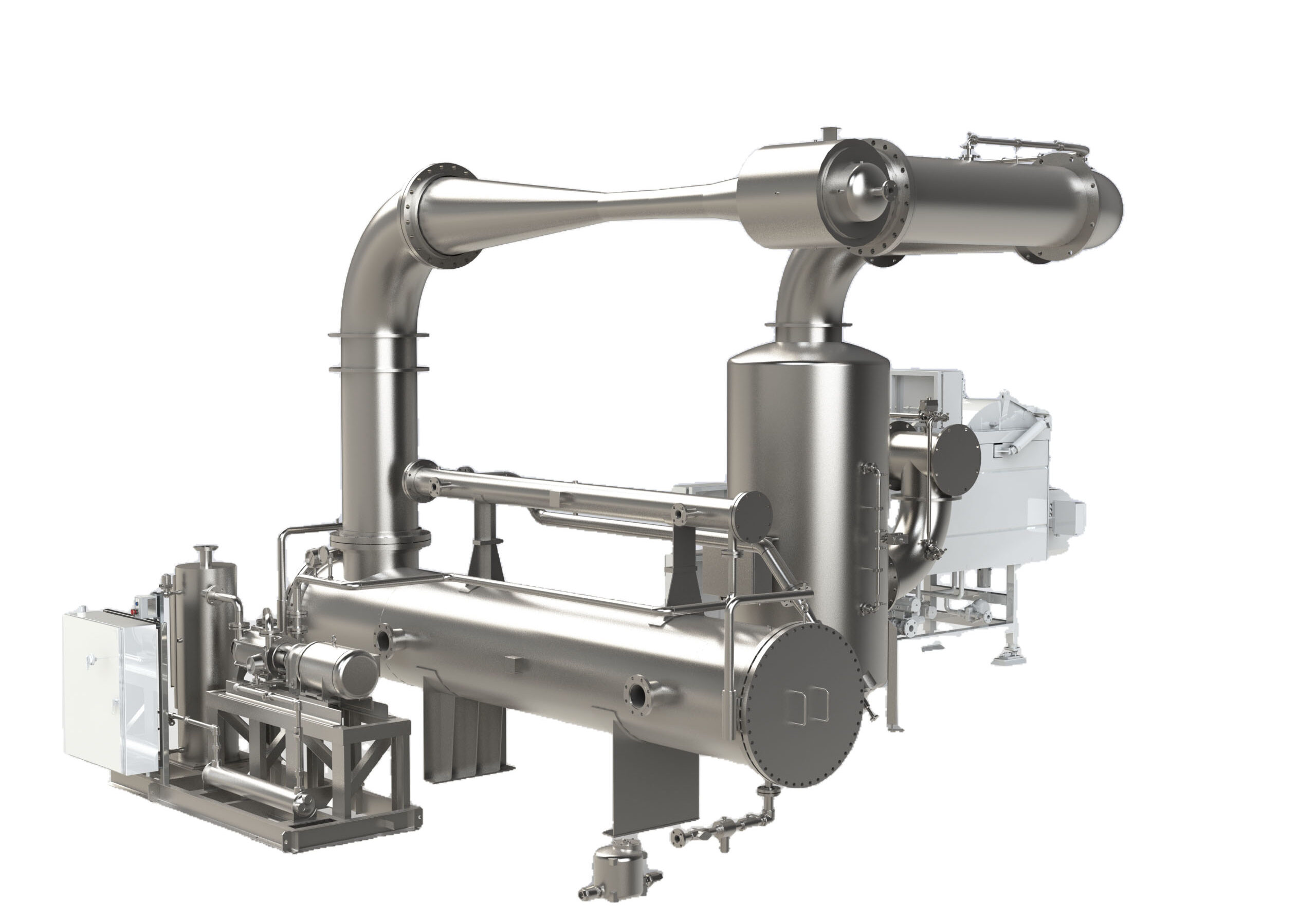
| Interchangeable shear screens to adjust particle size and smoothness
| Automated recipe control that stages or modulates shear based on viscosity
| High-flow loop design ensuring complete product pass-through and uniform shear exposure
By integrating these tools, shear becomes a controllable process variable — as measurable and repeatable as temperature or vacuum.
Why Controlled Shear Improves Results
Vacuum cookers that use hybrid steam ejector + liquid ring pump systems can reach deep vacuum levels efficiently. Compared to atmospheric boil-down or continuous open-reduction, this approach:
Eliminates the need for additional shear machines by achieving target textures directly in the process loop.
- Design Note: For multi-vessel systems, a single shear pump can be shared across machines to maximize utility.
Creates stable emulsions that resist separation during storage or reheating.
Improves yield and sanitation by reducing residue on discharge.
Enables a single system to handle both coarse and fine textures with quick adjustments.
Practical Operation Notes
Shear acts like seasoning — a little changes everything.
- Too little, and the product stays grainy, unstable, or prone to separation.
- Too much, and you risk destroying protein structures—losing meltability and stretchability—or turning defined particulates into mush.
- Uniformity is key: It’s not just about movement; the entire batch requires uniform treatment. Our systems ensure every portion of product receives the precise amount of shear needed, without overmixing or dead spots.
- Geometry matters: Screen size and head selection often shape results more effectively than raw speed alone.
Shear as a Process Variable
Modern processing treats shear as an adjustable engineering tool — alongside heat, agitation, and vacuum.
Controlling shear allows processors to fine-tune texture, mouthfeel, and product stability with precision, making every batch consistent and repeatable across scales.
Ready to refine your process?
Discover how Blentech shear systems deliver consistent results across applications, scales, and product types.