
Vacuum Cooling Technology
Cool from the inside out to achieve rapid, uniform temperatures without mechanical stress.
Fast, even chilling by changing pressure — not just temperature.
Why Vacuum Cooling Is Different
Traditional cooling methods work from the outside in — chilled jackets, cold water, cryogen, or air. Vacuum cooling works from the inside out.
When pressure around a hot product is reduced, the boiling point of water inside that product drops. Suddenly the moisture is above its new boiling point — it flashes into steam, and that evaporation pulls heat directly out of the product mass.
Boiling Point Drops as Pressure Drops
- At normal atmosphere (14.7 psi / 760 mmHg), water boils at 212°F (100°C).
- Under vacuum, boiling can occur at 140°F (60°C) and easily gets as low as 40°F (4°C), or even to 32°F (0°C) if the process requires it.
- Around 95–104°F (35–40°C), basic vacuum/pump systems begin to lose efficiency — condensers can't condense vapor fast enough. To keep cooling efficiently beyond this point, steam ejector stages are introduced to deepen vacuum and maintain vapor flow.
The result: rapid, predictable temperature drop without damaging the product.
Flash Cooling in Motion
Inside the cooker or mixer:
- Pressure is reduced.
- Surface and internal moisture begin to boil.
- Each pound of flashed moisture carries away a large amount of latent heat.
Product temperature falls evenly — not just at the surface.
Cooling Curve Control Protects Quality
Prevents over-flash or foaming.
Where cooling is most effective.
To protect yield and structure.
In small or low-mass batches, deeper vacuum can push the product close to freezing. Systems can recirculate vapor at this stage to stabilize temperature and prevent overcooling.
Step 1 of 3
Vacuum vs. Conventional Cooling
Conventional
- Surface cools first — core lags behind
- Cooling depends on surface area, agitation, and time
- Long cycles or high agitation can cause smearing, over-shearing, or texture damage
- High energy or CO₂ cost at scale
Vacuum
- Core and surface cool simultaneously
- Driven by thermodynamics — consistent cycle every time
- Gentle, even cooling that protects product integrity and yield
- Runs on steam, water, and vacuum — lower operating cost
Types of Vacuum Cooking & Cooling Systems
Basic Vacuum Cooling
Typical Cooling Range~130–150°F(54–66°C)
Process Description / ComponentsPump Only. Liquid ring pump system without additional steam ejectors.
Best ForMoisture Removal & Concentration. Ideal for fruit bases, jams, and sauces where the goal is water removal or initial cooling, rather than chilling to storage temperatures.
Single Stage System
Typical Cooling Range~85–90°F(29–32°C)
Process Description / ComponentsPump + Condenser. Liquid ring pump paired with a condenser to handle vapor more efficiently than a pump alone.
Best ForEntry-Level Cooling. Best for products that only need to reach ambient temperatures or where cooling water temperature is the limiting factor.
Two Stage System
Typical Cooling Range~40°F(4°C)
Process Description / Components1 Ejector + Condenser + Pump. Adds a steam ejector to bridge the gap between ambient cooling and refrigeration temperatures.
Best ForStandard Food Cooling. The industry standard for rapidly cooling meats, slurries, and ready-meals down to safe storage temperatures.
High Efficiency Multistage
Typical Cooling Range≤40°F(≤4°C)
Process Description / Components2+ Ejectors + Condensers + Pump. Advanced staging with multiple ejectors and inter-condensers to optimize steam usage.
Best ForHigh Volume & ROI. Designed for large-scale production. Delivers the same deep cooling as a two-stage system but saves 50–60% on energy costs.
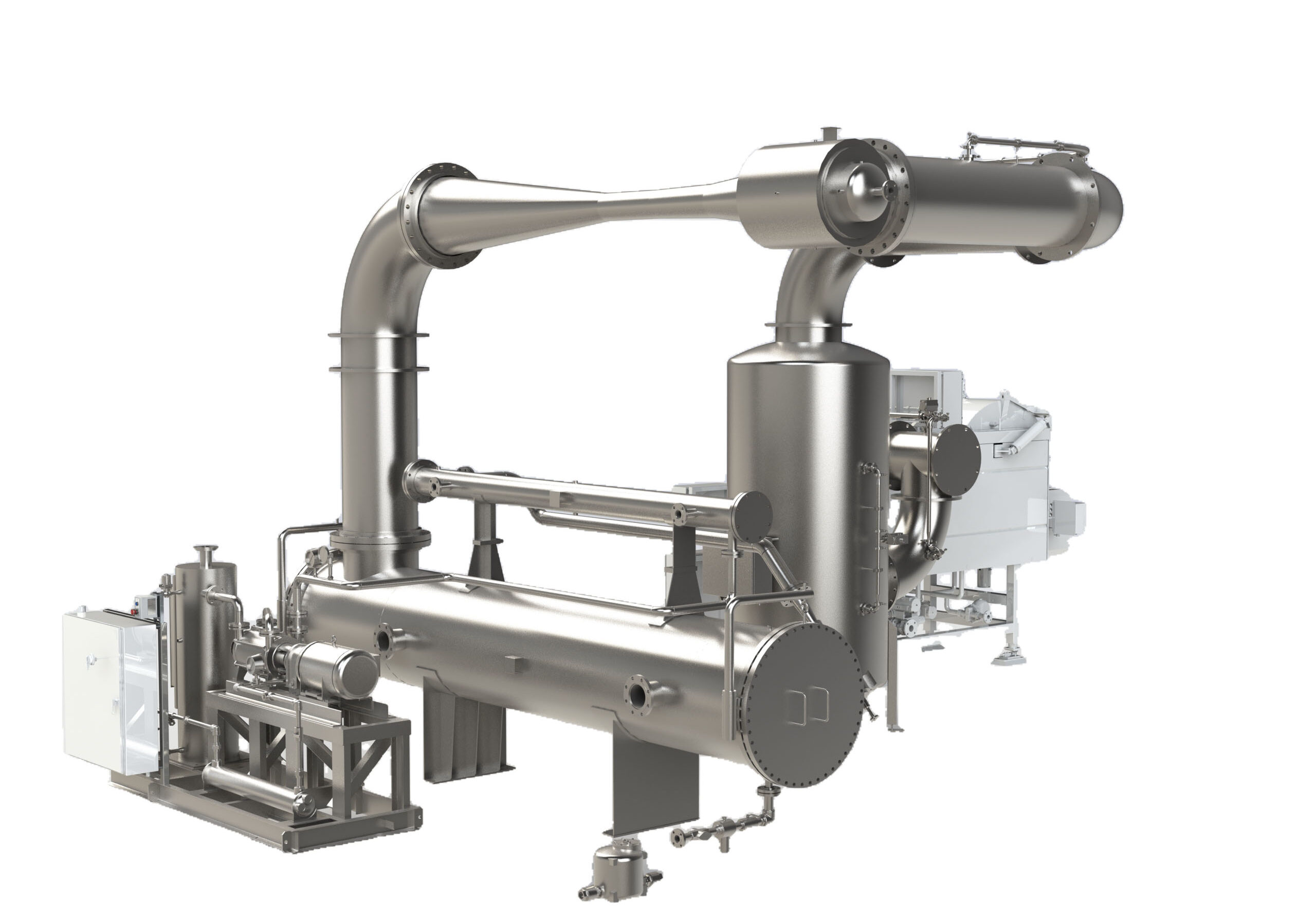
Hybrid systems — combining a steam ejector for deep pull with a liquid-ring pump for efficiency — are preferred in most food processing environments because they reduce steam and cooling-water demand, and with Blentech’s water-reclamation system, can eliminate over 90% of wastewater.
Why Condensers Matter
A high-velocity steam ejector creates a low-pressure zone. Once vapor is pulled into the condenser, it collapses from gas back to liquid — shrinking volume by roughly 1,000×. This creates a secondary vacuum boost and keeps cooling efficient through the final phase.
Practical Operation Notes
To maintain consistent vacuum cooling performance:
Use dry steam for ejectors — wet steam erodes nozzles and reduces vacuum depth over time.
Inspect ejector nozzles periodically — yearly with wet steam, every 2–3 years with clean steam. Keeping a spare nozzle on hand prevents downtime.
Keep condenser passages clean — fouling increases cooling time and utility cost.
Blentech condensers are built for full disassembly and inspection, with pass-through tube designs that allow complete cleaning of both sides.
These small maintenance practices have a large impact on cycle time and operating efficiency over the system’s life.
Vacuum as Part of a Cooling Strategy
Many processors vacuum-cool to 40°F (4°C) and, if needed for forming or crusting, apply a short cryogenic burst.
However, Blentech vacuum systems can often eliminate cryogen use entirely, offering ROI in just a few months while preserving texture and yield.
| Vacuum cooling can also be retrofitted into existing cook rooms, improving throughput without new chillers or cookers.
|By lowering filling temperatures, it can relieve spiral chiller bottlenecks and increase plant capacity.
| Products can also be vacuum-transferred from existing kettles into dedicated coolers, freeing up cook time and increasing production efficiency.
Beyond Cooling – Other Applications of Vacuum
Vacuum is a versatile processing tool beyond cooling:
- Acceleration of mass transfer – speeds osmotic infusion or absorption.
- Degassing and deaeration – removes entrapped air for smoother textures.
- Culinary reduction – enables rapid, low-temp concentration for sauces.
- Flavor infusion – accelerates infusion for fruits, marinades, and inclusions.
- Gel structure control – reduces bubbles or controls the distribution of inclusions.
- Vacuum impregnation – enables precise infusion of antioxidants or functional ingredients.
- Inline or recirculating concentration – enables rapid evaporation for syrups or concentrates.
Vacuum isn’t just a cooling method — it’s a multifunctional process variable that extends capability across cooking, cooling, and concentration.
Simple. Adaptable. Built to Scale.
Blentech’s vacuum cooling systems are built around robust pressure vessel engineering, hygienic design principles, and smart automation—delivering rapid flash cooling, maximized yield, and high-efficiency performance for processors who demand more.